Table of Contents
When people shop for THCA flower, the first thing they usually notice is the percentage printed on the label. Higher numbers often feel like a shortcut to better quality or stronger results. In reality, potency is far more layered than a single figure. Understanding how THCA works, how it converts when heated, and what actually affects perceived strength helps you make smarter choices and avoid chasing misleading numbers.
Quick Answer: Why THC % Is Misleading
THC percentages are commonly treated as a ranking system, but they only represent chemical potential under lab conditions. With THCA flower, most of the cannabinoid content exists in its acidic form, which behaves differently once it’s actually used.
- THCA percentage reflects raw material, not finished output
- Heating efficiency varies between products and users
- Terpene loss and dryness reduce real-world performance
- Higher numbers don’t guarantee stronger perceived results
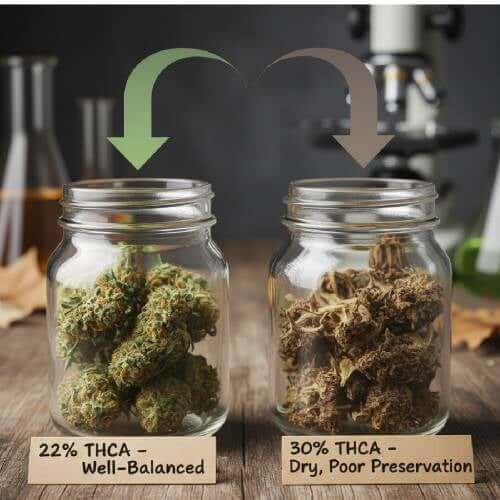
This explains why a well-balanced 22% THCA flower can feel more satisfying than a dry 30% option with poor preservation.
How THCA Converts When Heated
THCA itself is non-psychoactive. It must be heated to convert into delta-9 THC through a process called decarboxylation. This conversion is influenced by temperature, duration, and the condition of the flower.
- Too much heat can degrade cannabinoids before conversion
- Uneven burning leads to inconsistent output
- Moisture levels affect how smoothly conversion occurs
Because conversion is never perfect, some THCA is always lost during use. This means the final result is lower than the number printed on the label.
Pre-roll products like GOO'D Extracts Snow Cones THC-A Pre-Rolls and Hidden Hills Lil Hash Homies THCA Pre-Rolls often feel stronger than expected because they are designed to optimize burn consistency and delivery rather than simply maximize lab percentages.
Total THC vs THCA Explained
Many consumers confuse THCA with total THC. These values serve different purposes and shouldn’t be treated interchangeably.
- THCA shows how much acidic precursor is present
- Total THC estimates potential output after conversion
- Total THC is calculated, not directly measured in use
Total THC numbers assume ideal conversion conditions, which rarely happen in real-world use. As a result, they are best used for general comparison rather than as a promise of performance.
A flower with slightly lower total THC but better structure and freshness often delivers a more consistent experience than a higher-number flower that was poorly cured or stored.
Hidden Hills Lil Hash Homies THCA Pre-Rolls 1g

$28.99
Hidden Hills Lil Hash Homies THCA Pre-Rolls Creating another unworldly experience, the Hidden Hills Lil Hash Homies THCA Pre-Rolls are worth every penny. Inside of the jar, there are ten perfectly wrapped pre-rolls, filled with the highest quality THCA flower.… read more
Terpenes and Perceived Strength
Terpenes play a major role in how strong a flower feels. While they are commonly associated with aroma and flavor, they also influence how cannabinoids are perceived during use.
- Richer terpene profiles create a fuller experience
- Fresh flower retains more volatile compounds
- Aroma intensity often correlates with perceived strength
Flower with strong terpene presence frequently feels more impactful than higher-THCA flower that has lost aroma through age or improper storage.
Products such as Sherbinskis Live Rosin Pre-Rolls highlight how terpene preservation can elevate perceived potency even without extreme THC percentages.
How to Compare Flower Correctly
To evaluate THCA flower properly, focus on multiple indicators instead of relying on a single percentage.
- Check full lab panels, not just THCA numbers
- Look for visible trichome coverage and healthy color
- Smell the flower for freshness and terpene presence
- Consider moisture balance and bud structure
Also consider how the product is meant to be used. Loose flower, pre-rolls, and infused options are designed differently and shouldn’t be compared solely on THCA percentage.
- Loose flower emphasizes versatility
- Pre-rolls focus on consistent delivery
- Infused products prioritize efficiency and balance
Consistency between batches often matters more than chasing the highest number available.
Conclusion
THCA flower potency isn’t defined by a single number. When you understand how conversion works, how terpenes influence perception, and how quality impacts delivery, it becomes much easier to choose flower that performs well instead of just looking impressive on paper.
FAQs
Is higher THCA always better?
No. Higher THCA only shows potential. Real-world strength depends on conversion efficiency, terpene content, and overall quality.
Why does lower-percentage flower sometimes feel stronger?
Better freshness, terpene preservation, and smoother conversion often lead to stronger perceived results.
Does total THC matter more than THCA?
Total THC provides a broader estimate, but it is still theoretical and should not be treated as a guarantee.
Are infused pre-rolls stronger than flower?
They often feel stronger because they are engineered for efficient delivery, not just higher cannabinoid numbers.
What should I look for besides percentage?
Focus on aroma, trichomes, moisture balance, lab transparency, and consistency across batches.