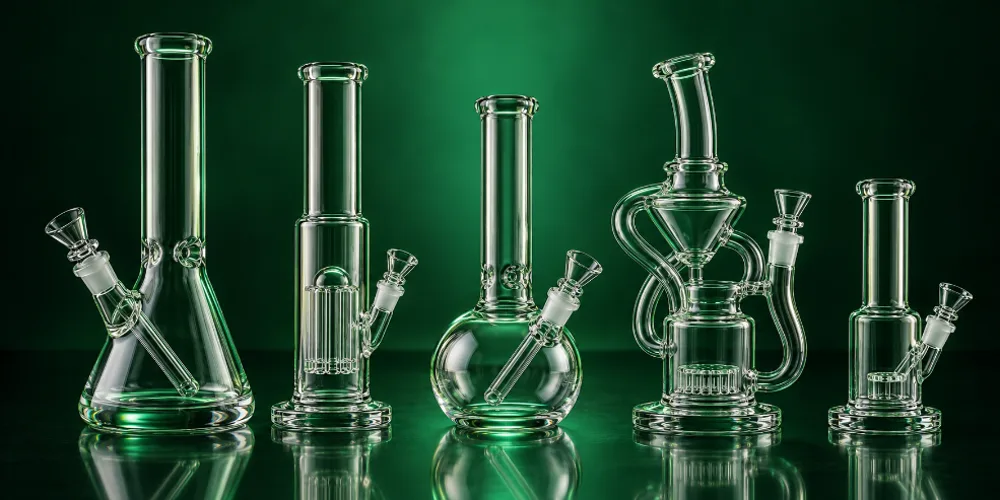

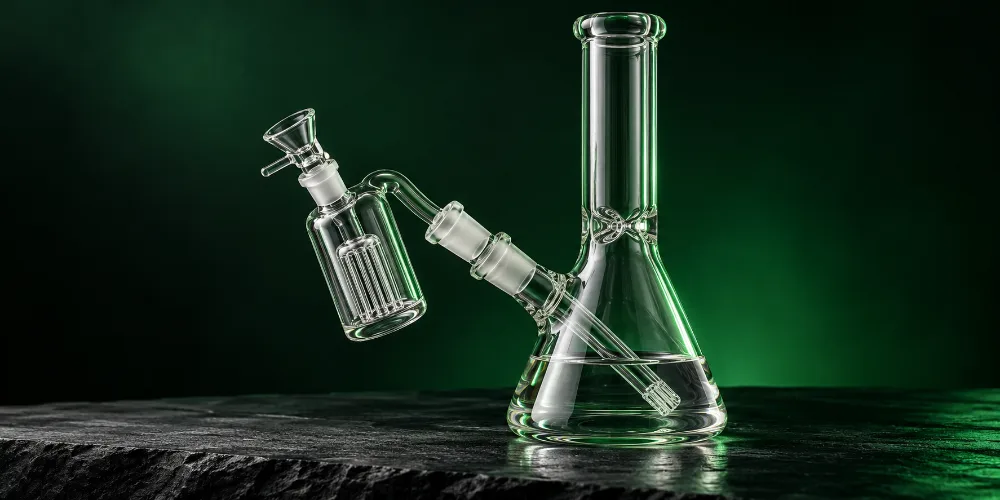
An ash catcher is a small glass attachment that fits between your bowl and your water pipe. It traps ash and residue before they reach the main chamber, so your piece stays cleaner for longer. To pick one, match your joint size (14mm or 18mm), your joint angle (45 or 90 degrees) and choose a weight your pipe can balance.
Key takeaways
- An ash catcher keeps ash and residue out of your water pipe, so the main glass needs cleaning far less often.
- Match three things: joint size (10mm, 14mm or 18mm), joint gender and joint angle (45 or 90 degrees).
- A 45 degree catcher suits pipes with angled joints, usually straight tubes and beakers. A 90 degree catcher suits pipes with joints that point straight up.
- Heavy catchers can tip small pipes. Keep it light on anything under about 10 inches tall.
What does an ash catcher do?
It catches ash, loose herb and residue before they reach your water pipe. Most ash catchers also hold a little water, which adds another layer of filtration.
Think of it as a filter you can rinse in a minute. Instead of deep cleaning a large piece every few days, you dump and rinse a small attachment, and the main chamber stays clear much longer. A wet ash catcher also adds a little extra cooling before smoke reaches the main water.
What size ash catcher do you need?
Match the joint size on your water pipe. Most pipes use 14mm or 18mm joints, and the ash catcher needs the opposite gender to plug in.
- Measure the joint: measure the width of the joint, or check your pipe’s product listing. A 14mm joint is a little over half an inch across; an 18mm joint is closer to three quarters of an inch.
- Check the gender: a female joint on the pipe takes a male ash catcher, and vice versa.
- Check the bowl: your bowl must fit the ash catcher’s top joint. Many catchers come in 14mm to 14mm or 18mm to 18mm.
- Use an adapter only if needed: adapters add height and weight, which can make a small pipe tippy.
Should you get a 45 or 90 degree ash catcher?
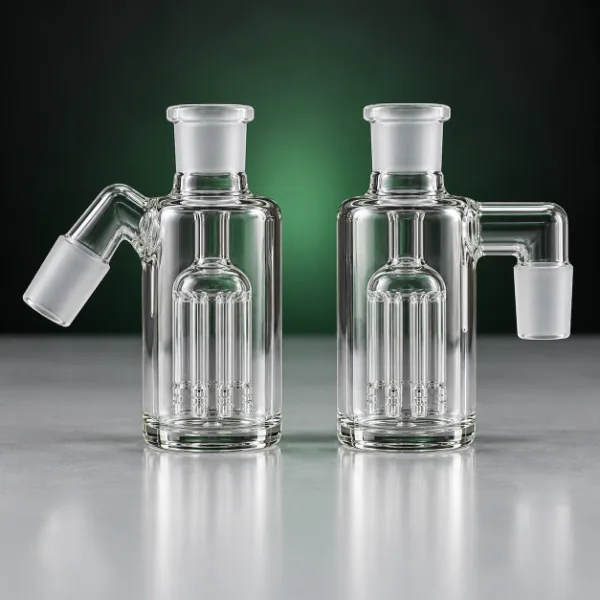
Choose the angle that matches your pipe’s joint. If the joint sticks out at an angle, use a 45 degree catcher; if it points straight up, use a 90 degree catcher. The goal is for the catcher to sit upright.
| Choice | Fits | Why it matters |
|---|---|---|
| 14mm joint | Most small and mid-size water pipes and bubblers | The most common size. Wide choice of bowls and catchers. |
| 18mm joint | Larger and thicker water pipes | Bigger airflow. Heavier glass, so check balance. |
| 45 degree angle | Pipes with angled joints, common on beakers and straight tubes | Keeps the catcher upright on an angled joint. |
| 90 degree angle | Pipes with vertical joints, common on many percolator pieces | Sits straight up on a vertical joint. |

Glass worth showing off
Find a water pipe
Beakers, straight tubes and recyclers in 14mm and 18mm. Free US shipping over $49.99.
What types of ash catchers are there?
Ash catchers come in dry and wet designs, and wet ones use different percolators. The percolator changes how much the smoke is broken up and how hard the draw feels.
Dry
Dry ash catcher
No water. Light and easy to clean, but filters less. Good for small pipes.
Wet
Tree percolator
Several arms with small slits. Good diffusion, but thin arms can break.
Wet
Showerhead or inline
A slotted or holed base spreads smoke evenly. Sturdy and easy to clean.
Wet
Recycler style
Water loops inside the catcher. Smooth, but larger and heavier.
More percolation adds drag, meaning you pull a little harder. If you like a light, easy draw, stick with a dry or simple inline design.
Will an ash catcher make my bong tip over?
It can, if the catcher is heavy and the pipe is small. Weight sits high and to the side, so balance matters more than size.
- Keep heavy, multi-perc catchers for pipes with a wide, thick base.
- On pipes under about 10 inches, choose a light dry or simple inline catcher.
- Avoid stacking adapters, which adds height and leverage.
- Use a silicone or wide base pad on hard surfaces for extra stability.
A sturdy, wide-base pipe like the Wulf Mods 7mm 12 inch beaker water pipe handles extra weight much better than a slim mini tube.
How do you clean an ash catcher?
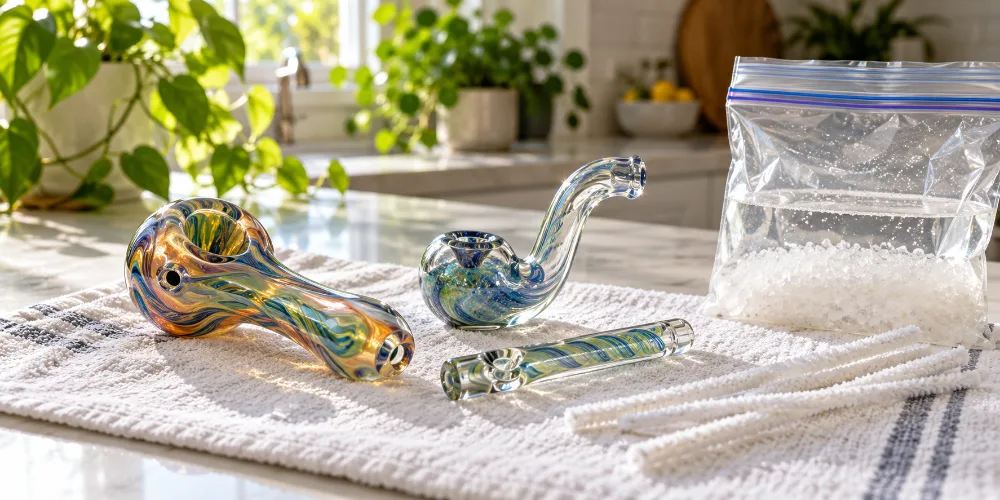
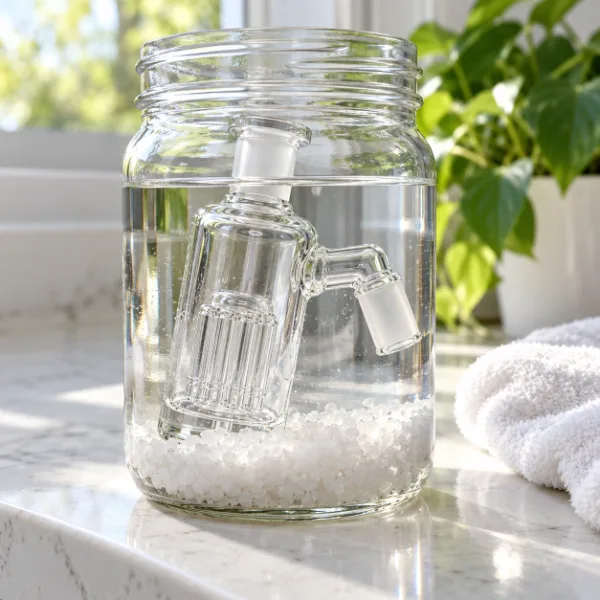
Empty it after each session, then soak it in isopropyl alcohol and coarse salt once or twice a week. Because it is small, cleaning takes only a few minutes.
- Remove the ash catcher and dump the water and ash.
- Rinse with warm water.
- Place it in a zip-top bag with coarse salt and 91% or stronger isopropyl alcohol.
- Shake for a minute, then soak for 10 to 20 minutes.
- Rinse well with warm water and let it air dry before reattaching.
For a full walkthrough, see our guide on how to clean a bong. A soak cleaner from Grunge Off also works if you prefer not to shake glass.
Keep it clean
Shop glass cleaners
Soak cleaners that need no scrubbing or shaking. Great for small attachments.
Is an ash catcher worth it?
If you use a water pipe often, yes. It saves cleaning time and keeps your main glass clearer. If you use a small pipe only occasionally, the extra weight may not be worth it.
A good rule of thumb: if you clean your water pipe more than once a week, an ash catcher will likely pay for itself in time saved. If you mostly use a small piece now and then, a dry catcher keeps things light. Either way, buy the catcher after you know your pipe’s joint size, gender and angle, so it fits on the first try.
Frequently asked questions
Do ash catchers really work?
Yes. An ash catcher traps ash and residue before they reach the main chamber of your water pipe, so the main glass stays cleaner and needs deep cleaning less often. Wet ash catchers add a small extra layer of water filtration too. You still need to empty and rinse the catcher itself regularly.
Do you need to put water in an ash catcher?
Only if it is a wet ash catcher with a percolator. Fill it so the percolator is just covered, usually a small amount. Dry ash catchers are designed to run without water and simply collect ash. Too much water in a wet catcher can splash into the main pipe, so start low.
Can you add an ash catcher to any bong?
You can add one to most water pipes with a removable bowl and a standard 10mm, 14mm or 18mm joint. Match the joint size, gender and angle, and make sure the pipe is stable enough to carry the extra weight. Pipes with fixed bowls cannot take an ash catcher.
What is the difference between a 14mm and 18mm ash catcher?
The number is the joint size. A 14mm catcher fits 14mm joints, which are the most common on small and mid-size water pipes. An 18mm catcher fits larger joints found on bigger pieces. Check the joint on your pipe and choose the matching size and opposite gender.
How often should you clean an ash catcher?
Empty and rinse it after every session and give it a deep clean with alcohol and coarse salt once or twice a week with regular use. Because it is small, it only takes a few minutes. A clean catcher keeps airflow steady and stops residue from passing into your main pipe.
100% Authentic from top brand names
Shop all glass
Free US shipping over $49.99, $9.99 flat under that. Ships within the USA to adults 21+.
Pick the right ash catcher
Match the joint size, gender and angle, keep weight in proportion to your pipe and rinse it often. If you are choosing a new piece to pair with one, start with our water pipes collection.